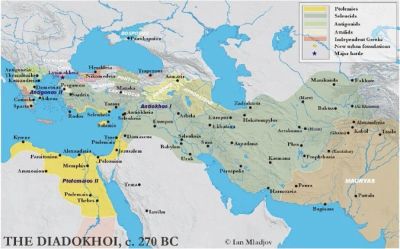
319BCE - 302BCE - Jerusalem changes rulers 7 times.
260BCE - Beit She'an re-founded as Scythopolis (included in the Decapolis 10 towns listing) by Ptol
200BCE - The Seleucid emperor, Antiochus III, defeats the Egyptian Ptolemaic army in a huge battle a
174BCE - The pagan Seleucid's of Antioch exert strict control over the land of Israel and appoint J
For the next 100 years, the office of Jewish High Priest is best described as a charade and sold to the highest bidder,
172-169BCE - Menelaus offers a higher bribe to Antiochus and is appointed high priest in Jerusalem.
167-164BCE - The Seleucid governor, Antiochus IV outlaws Judaism in Judea. Completely desecrates t
Mattathias Hasmoneus, a priest from Modi'in, takes up arms alongside his five sons to oppose the pagan actions of Antiochus IV. This pivotal moment marks a significant point in the history of Israel. In 166 BCE, Judas Maccabeus assumes leadership of the revolt.
164BCE - Maccabees Recapture Temple. A new sect known as the Pharisees claims Mosaic authority for e
The Maccabees recaptured the Temple and rededicated it, marking a significant event in ancient Israel events.
However, a faction of Pharisees took a stand against the Maccabee position of holding both King and High Priest roles, leading them to leave Jerusalem for Qumran, a site connected to the legacy of the Dead Sea Scrolls. This period is also recognized as the origin of Hanukkah.
160BCE - Maccabees defeated by Seleucids of Damascus.
Judas Maccabeus, is killed by the Seleucids in the Mt. Arbel area. During this period, the first scrolls were being written by the Essenes in Qumran, leading to the creation of the Dead Sea Scrolls, which continue to provide incredible insight into authentic Jewish practices.
142BCE - Maccabee heir, Simon Thassi becomes first prince of Hasmonean rulers.
141BCE - Simon Thassi establishes Pharisee dynasty. For almost 600 years Galilee has been vacant.
141BCE - Pharisees agree the line of Simon should lead as high priest until a faithful prophet arise
The next faithful prophet to emerge in the history of Israel will be in 28 CE, in the Judean desert near Jericho and Aenon. His name is Johanan the Immerser, the forerunner to the Messiah. All of Jerusalem is coming out to him. This pivotal moment in ancient Israel events marks the announcement of Yeshua of Nazareth as the Messiah, yet the Jewish leadership pays no heed and opposes these significant words.
134BCE - Maccabee J. Hyrcanus has to loot tomb of David to pay Antiochus VII 3000 talents of silver.
Referring to Maccabee leadership in the context of ancient Israel events, the Jewish sage Nittai of Arbel writes, 'distance yourself from a bad neighbor, consort not with an evil man,' highlighting moral lessons that are significant within the broader history of Israel and the Jewish history timeline.

112BCE - Jewish Hasmoneans destroy Samaritan temple at Mt. Gerizim and Shechem.
108 BCE - Jewish Hasmoneans destroy Beit Shean.
In 104 BCE, Hyrcanus's son, Aristobulus I, ascends to the throne as king of Judea. His reign lasts for 2 years and is marked by despotic actions. He forces his position to simultaneously serve as both king and high priest, leading to the imprisonment of his mother, who tragically starves to death, as well as his three brothers. These disastrous leadership decisions are pivotal in the history of Israel. Following him, Alexander Jannaeus is chosen as the next king, reigning for 27 years. His cruelty knows no bounds as he persecutes the rabbis and effectively eliminates the Sanhedrin, reflecting a dark chapter in the Jewish history timeline.
75 BCE - Salome Alexander appointed defacto Queen of Judea. She reestablished the Sanhedrin.
Alexander Jannaeus (also known as King Yannai). Hasmonean king and high priest, a dynasty established by the Maccabees.
Around 76 BCE, after crushing a rebellion largely led by the Pharisees, Jannaeus famously crucified 800 rebel leaders outside Jerusalem. According to historical accounts recorded by the historian Flavius Josephus, Jannaeus hosted a banquet with his concubines, where he dined while watching the executions of the rebels' wives and children.
75 BCE - Salome Alexander appointed defacto Queen of Judea. She reestablished the Sanhedrin.
The Pharisees emerged as the ruling class, determined to maintain their authority. Salome took decisive action by removing the Sadducees from Jerusalem. According to the Talmud, her piety was rewarded when rain fell only on Shabbat night, leading to a significant increase in soil fertility. Notably, she was the sister of Shimon ben Shetach, a Mishnaic sage and Nasi of the Sanhedrin.
63BCE - But a Non Jew, wealthy Nabataean intervenes - Antipater, father of Herod the Great turns the
Antipater convinces the king of the Nabataeans, Aretas, to side with Hyrcanus and fight for the Jewish crown, a significant moment in the history of Israel. The civil war is only resolved when one side asks Roman general Pompey to intervene. This conflict among quarrelling Jewish brothers opens the door to total Roman rule, marking a pivotal point in the ancient Israel events. Pompey ultimately decides to settle the war by keeping Israel for himself and Rome, which signifies the beginning of the Roman Period in the Jewish history timeline.
44BCE - Julius Caesar killed.
During the history of Israel, there were periods of temporally relaxed Roman rule on ancient Israel events that significantly influenced the Jewish history timeline.
40BCE - Herod visits Rome - Appointed King by Roman Senate.
In 40 BCE, the Parthian Empire invaded the eastern Roman provinces, including Judea. Antigonus II Mattathias, a member of the Hasmonean dynasty seeking to reclaim the Judean throne, allied himself with the Parthians. With their support, Antigonus successfully overthrew the Roman client ruler Hyrcanus II and declared himself king of Judea. He garnered the allegiance of both the Jerusalem aristocracy and the Pharisees' leaders, who were discontent with Roman rule, indicating a level of Jewish support for the pro-Parthian Hasmonean claimant. Following Antigonus's rise, Herod, a staunch supporter of Rome, fled Judea. He traveled to Rome, where the Roman Senate appointed him King of the Jews in 40 or 39 BCE. Subsequently, Herod returned to Israel with Mark Antony, conquered Antigonus II, and executed him, marking the end of Hasmonean rule in 37 BCE. Herod then divorced his first wife, married Mariamne, a Hasmonean princess, and plotted to eliminate the last male Hasmonean heir at his Jericho palace.
36BCE - Jewish Zealots in Galilee rebel against Herod. Herod kills this group at Mt. Arbel cliff.
The Roman legion siege camp was built atop Mt. Nitai, in order to lay siege to the Jewish zealots hiding in the caves of Mt. Arbel. The Romans are having difficulty defeating the Zealots and call for Herod's assistance. Herod arrives with re-enforcements and the Zealots are defeated and Herod is not fully entrenched as part of the Roman ruling occupation.
31BCE - Powerful earthquake in Judea. The devastation of this earthquake opens the door for Herod t
Throughout the history of Israel, several significant ancient Israel events were marked by earthquakes, some of which were notably followed by tsunamis. Key instances occurred in 92 BCE, 115 CE, 306 CE, 502 CE, 552 CE, 881 CE, and 1202 CE, contributing to the broader Jewish history timeline.
27BCE - close friend of Herod's, Augustus, appointed Roman Emperor. Reign for 41 years till 17CE.
Augustus is recognized as the first Roman emperor, playing a pivotal role in ancient Israel events, particularly in Herod's appointment as the ruler of Judea. At this point in the history of Israel, Herod receives control over the territories of Jericho, Gadara, Hippos, Samaria, Gaza, Anthedon, Jaffa, and Strato's Tower, which would later be known as Caesarea Maritima. In a significant moment in the Jewish history timeline, Herod undertakes the rebuilding of Samaria, renaming it Sebastia.

23BCE - Herod builds the Herodium 7.5 miles south of Jerusalem.
22BCE - Herod begins construction of Caesarea Maritima on old settlement known as Strato's Tower.
Maritima will become the largest port in the eastern Mediterranean Sea, marking an incredible engineering accomplishment in the history of Israel. This port will soon serve as the home of the Roman procurators sent to rule Judea, following the dismissal of Archelaus in 6 CE. By 26 CE, it will also become the residence of Pontius Pilate, a significant figure in Jewish history timelines and ancient Israel events.
20BCE - Herod's son, Antipas is born. He is raised with a close friend, Menachem.
Menachem will later hold an extremely important position as the intermediary of the Sanhedrin and Antipas during significant ancient Israel events. Shockingly, Menachem will become a follower of Yeshua of Nazareth, leaving the Sanhedrin and moves to Antioch. The next time his name is encountered, he is praying for his former associate, Saul of Tarsus, at Antioch. He is considered a prophet and teacher in the Antioch church and was present when Barnabas and Saul (Paul) were sent out on their first missionary journey around 47/48 CE,
19BCE - Herod begins rebuilding the Temple in Jerusalem in the eighteenth year of his reign.
The history of Israel is rich and complex, featuring numerous ancient Israel events that have shaped the cultural and religious landscape of the region. A comprehensive Jewish history timeline can help us understand the significant milestones and transformations that have occurred throughout the centuries.
10BCE - Caesarea Maritima is completed after 12 years of work.
In the context of ancient Israel events, 7 BCE marks a significant moment in the history of Israel when Herod, driven by mistrust, has two of his sons, Alexander and Aristobulus, executed, which is a notable entry in the Jewish history timeline.
+-6BCE - Likely year of birth of Jesus of Nazareth in Bethlehem.
Due to a death threat against the child, Yeshua is taken to Egypt, likely settles in Alexandria, where a significant Jewish community already thrives. At this time, the Jewish community is led by the esteemed Jewish philosopher Philo and his family, who maintain direct connections with Herod and the priesthood of Jerusalem. Philo's writings serve as a substantial secondary historical source for understanding ancient Israel events during this time. Philo's brother is recognized as the wealthiest man in Egypt.
The 'Gabriel Stone' has an unknown provenance, but it may originate from the Jordanian side of the Dead Sea. This ink-on-stone artifact contains a collection of short prophecies penned in the first person by someone identifying as Gabriel, dating back to the 1st century BCE or the early 1st century CE based on its script and language. These prophecies outline Messianic points, and analysis suggests a date post-50 CE, approximately 20 years after the death and resurrection of Jesus of Nazareth. This artifact may be particularly interesting within the context of the history of Israel as it potentially describes a 3-day resurrection occurrence.
5BCE - Herod's son, Antipater, sees his father in very poor health and attempts to poison him.
In the timeline of Jewish history, around 5-4 BCE, a significant event in ancient Israel occurs when Herod has his son Antipater killed. Following this, Herod faces a very painful death, marking a notable moment in the history of Israel.
In the history of Israel, during the year 4 BCE to 6 CE, Herod's son Archelaus reigns over Judea, which is marked by significant ancient Israel events. During this time, the young Jesus, around 10 years old, and his family return to Israel, seeking to settle in Judea. However, upon finding Archelaus in power, they decide to move north to the small village of Nazareth in Galilee. Notably, Archelaus was later declared unfit to reign in 6 CE, a crucial point in the Jewish history timeline.
Around 4 BCE to 6 BCE, during significant ancient Israel events, Herod's son Antipas is approximately 17 years old when his father passes away. Following this, he is appointed tetrarch of Galilee and commences the rebuilding of Sephoris, located just 4 miles from Nazareth. This important development in the history of Israel likely provides much-needed employment for Jesus' family until around 18 CE, highlighting a key moment in the Jewish history timeline.
9CE - Pharisee leader, Hillel the Elder dies. The house of Rabbi Shammai rises.
In 14 CE, Emperor Augustus died at the age of 75, marking a significant moment in the history of Israel. He was succeeded by his adopted son Tiberius, who would reign for 23 years until 37 CE. This period is notable in the Jewish history timeline and is part of the broader ancient Israel events.
In the context of ancient Israel events, 18CE marks a significant moment when Caiaphas offers the highest amount of money to Roman Prefect Valerius Gratus and ascends to the position of high priest. During this time, Antipas begins work on his new capital of Galilee in Tiberias. It is possible that Yeshua, as part of the unfolding history of Israel, follows this development and works as a stone mason in Tiberias for a period.
23CE - Valerius Gratus is appointed prefect of Judea.
26CE - the emperor appoints Sejanus as his executive officer to manage affairs of the empire. The antisemite, Sejanus, has a desire to exterminate the uncontrollable Jewish race. He appoints Pontius Pilate to replace Gratus as the ruler of Judea. Pilate retains the high priest Joseph ben Caiaphas throughout his tenure. Caiaphas and the Sadducee priests are seen as completely reliable allies to both Pilate and Rome. Pilate's first unwise act is to install the embossed figures of the emperor at the Temple site, leading to a massive confrontation at Caesarea Maritima.
A solitary prophetic voice soon emerges in the Judean desert with Yohanan the Immerser, as all of Jerusalem comes out to hear him and be baptized by him. He is recognized as the next acknowledged prophet in the Jewish history timeline of Israel.
28/29CE - Antipas departs for Rome and divorces his wife, Phasaelis, the daughter of Nabbatean king, Aretas. During this time, Yohanan the Immerser begins his ministry in the Jordan Valley, as noted in Luke 3:1-2.
It is at this pivotal moment in ancient Israel events that the brief three-year ministry of Yeshua of Nazareth begins.